Chicken breast are so bland that they demand something—a spice rub, a salsa, or a strong reduction sauce. If you start with strong-tasting solids and add a variety of bold liquids, reducing each one to a syrupy consistency, you end up with an intense and complex reduction sauce. The process can involve esoteric ingredients and procedures, or it can be quite straightforward, like this one, which is direct, quick, and easy, especially considering that the result is a dark, complex sauce that can be used in many ways (see the variations).
I make tomato sauce often. I make a batch to use that same night, and freeze what is left over to pull out and cook with when I want to throw something together quickly, like a grilled pizza or a pasta. A ricer or food mill is an inexpensive piece of kitchen equipment and there are many sizes. This is the best way to puree this sauce.
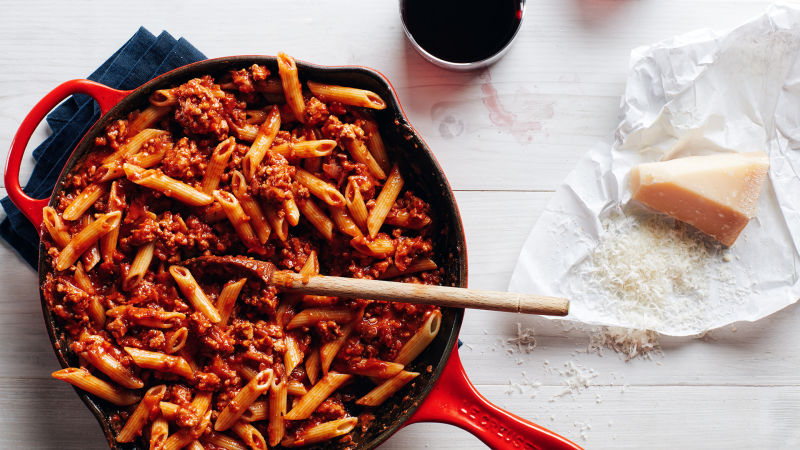
We hate to choose favorites—we love all our “children” equally—but this sauce is the one we go to again and again and again. It has the perfect amount of kick to it, but if you prefer it spicier, feel free to add more red pepper flakes. But please—this is a big tip coming—wait a minute or two after you’ve added the red pepper flakes before adding more. Give the peppers some time to hydrate and the spice to dissolve—a little chile goes a long way but takes time before it reaches its full potential. Of course we love this sauce over pasta and on a Smash (two balls on a brioche roll with sauce and cheese) too. Try tossing in a handful of arugula with the hot pasta and sauce and allowing it to wilt, adding a generous grating of parmesan cheese on top. Perfection!
Escoffier codified the mother sauces of French cooking. In the Italian-American tradition, there is only one: tomato sauce. Call it marinara (we do), call it gravy (we don't), call it whatever your grandma called it. It's tomato sauce. There's almost nothing we won't cook in it or put it on.
The real deal—what we grew up with and the way we would do it if we had our choice (and didn't have so many vegetarian friends and customers) would be to make that sauce, then simmer up a batch of braciola or meatballs in it, and then use the resulting meat-infused product as our "tomato sauce" in all its myriad applications. And if you're not catering to vegetarians, we advise doing just that: make a triple batch of sauce, use it to simmer up braciola or meatballs and then use that tomato sauce, fresh or from the freezer, whenever tomato sauce is called for in these pages.
Use good Italian canned tomatoes and high quality olive oil when making this sauce, and take your time—there's no rushing it. When you're cooking the garlic, you want to very, very slowly convert the starches in it to sugars and then to caramelize those sugars. Slow and steady. Then get the tomatoes in and let them simmer. Not a ton happens over the four hours—no epic deepening of color or furious reduction—but it cooks as much water out of the tomatoes as possible without turning them into tomato paste.
This is the sauce I make most often, and if it’s made out of good olive oil and good wine vinegar, it’s the best salad dressing I can imagine. At its simplest, vinaigrette is a mixture of vinegar and oil in a ratio of 1 part vinegar to about 3 or 4 parts oil. Start by estimating roughly how much vinaigrette you will need. This depends on what you’re using it for; a quarter cup is more than enough for four servings of green salad, for example, but you really never need to measure out exact amounts. Start by pouring the vinegar into a bowl. Dissolve a pinch of salt in it and taste for balance. The salt has a real relationship with the vinegar. When you add just enough salt, it subdues the acid of the vinegar and brings it into a wonderful balance. Try adding salt bit by bit and tasting to see what happens. How much salt is too much? How much is too little? What tastes best? If you add too much salt, just add a touch more vinegar. Grind in some black pepper and whisk in the oil. The vinaigrette should taste brightly balanced, neither too oily nor overly acidic. Adjust the sauce, adding more vinegar if you’ve added too much oil, and more salt, if it needs it.
It’s hard to imagine five minutes in the kitchen better spent than those spent making vinaigrette, the closest thing to an all-purpose sauce. The standard ratio for making vinaigrette is three parts oil to one part vinegar, but because the vinegars I use are mild and extra virgin olive oil is quite assertive, I usually wind up at about two parts oil to one part vinegar, or even a little stronger. Somewhere in that range you’re going to find a home for your own taste; start by using a ratio of three to one and taste, adding more vinegar until you’re happy. (You may even prefer more vinegar than olive oil; there’s nothing wrong with that.) Be sure to use good wine vinegar; balsamic and sherry vinegars, while delicious, are too dominant for some salads, fine for others. Lemon juice is a fine substitute, but because it is less acidic than most vinegars—3 or 4 percent compared to 6 or 7 percent—you will need more of it. The ingredients may be combined with a spoon, a fork, a whisk, or a blender. Hand tools give you an unconvincing emulsion that must be used immediately. Blenders produce vinaigrettes that very much resemble thin mayonnaise in color and thickness—without using egg. They also dispose of the job of mincing the shallot; just peel, chop, and dump it into the container at the last minute (if you add it earlier, it will be pureed, depriving you of the pleasure of its distinctive crunch). This is best made fresh but will keep, refrigerated, for a few days. Bring it back to room temperature and whisk briefly before using it.
Getting the consistency of the creamy mushroom sauce right is key for this pasta recipe. You want to reduce it just until it clings to the pasta to create a light coating; be careful not to reduce it too much.
http://slim-weight.today/recipe/pasta-with-mushrooms-and-prosciutto%3C/div%3E%3C/div%3E%3C/div%3E%3C/div%3E%3C/div%3E%3C/div%3E%3C/div%3E%3Cdiv class="StackedRatingsCardWrapper-RIFgn jsPKbl SummaryCollectionGridSummaryItem-ilztYA cpHIzM search_result_item-5b97da3f1ad6f7505fd201fa">
Before you convince yourself there's no way that a little onion, tomato paste, and half-and-half can come together in mere minutes to make one of the best homemade pasta sauces you've ever had, hear us out. Better yet, make this vodka sauce recipe for yourself. Just try and use double-concentrated tomato paste, which packs more flavor than the standard stuff.
Join Molly in the Test Kitchen as she makes Pasta al Limone. This classic lemon sauce recipe has a lot of fat and a lot of acidity, so don’t be shy with adding salt and taste as you go. It will likely require more than you think to strike that perfect balance.