Search results for
magazine sweeps fry pan entry
Filter Results
Sort By:
Recipes
(224)

Recipes
A dry rub, not buttermilk brine, is the secret to this flavorful fried chicken dinner.
4.0
(3.91)

Quick
Recipes
All you really need is melted butter and a hot oven to make perfectly pillowy popovers.

icon
Culture
Shop our editors’ favorite sheet pans, spices, and coffee grinders—all in one place.

icon
Cooking
We’ve got baked cheddar and leek pasta, maple-mustard sheet-pan salmon, and a strawberry shortcake roll.

Recipes
Tender cuts of meat—chicken breasts, steaks, and chops, for example—are prime candidates for pan-frying, and when properly cooked have a mouthwateringly crisp, browned exterior and a tender, juicy interior. Pan-frying makes dinner a breeze; there is practically no preparation involved and the meat is cooked quickly and sent straight to the table. The fundamentals for achieving good results are a heavy pan, high heat, and a fairly thin piece of meat. Why does a heavy pan matter? Have you ever cooked something in a thin pan and had it burn, with the burn exactly the same shape as the electrical element below? This shows how a thin pan transmits heat directly from the burner to what is cooking instead of diffusing the heat across the pan’s surface. A heavy pan can distribute heat—and a lot of it—from the burner to the bottom of the pan. This is key in pan-frying and sautéing, because the pan needs to be quite hot to sear and caramelize or brown, but not burn, the surface of what is being cooked. If I could have only one pan, it would be a cast-iron skillet. The heavy iron heats evenly, making it a wonderful vehicle for browning and frying. An added bonus is that a seasoned cast-iron pan is virtually nonstick. The next-best thing after a cast-iron skillet is a stainless-steel-lined heavy aluminum or aluminum-core frying pan. The aluminum is an excellent heat conductor, while the stainless steel offers a good nonreactive surface to cook on. Besides being heavy, the pan should have low sides so the meat won’t steam as it cooks. Because pan-frying requires high heat, the meat you choose should be fairly thin. Chops should be 1/2 to 3/4 inch thick and steaks 1 inch thick or less. Over high heat, thicker cuts will get crusty and dry on the outside before the inside is done. (A good method for cooking thicker chops and steaks is to brown them, by cooking them briefly on both sides at high heat, and pop them, skillet and all, into a 375°F oven to finish cooking. Alternatively, after browning, finish cooking over lowered heat, with the pan covered.) For even cooking, the thickness should be uniform. Chicken breasts can be lightly pounded at the thicker end to even them out so they will cook consistently. It is wise to have all your ingredients ready to go before you start cooking: the oil should be handy, the meat should be seasoned, and, if you are going to make a pan sauce, those ingredients should be on hand as well. Heat the pan first: a hot pan in combination with oil will sear the meat and keep it from sticking. Otherwise, the meat will sweat and its leaking juices will cause the meat to adhere to the bottom of the pan. Once the pan is hot, add a little bit of oil, or oil and butter (butter alone burns too quickly at high temperatures). Add the oil after the pan has heated so that it does not start to smoke and burn before you are ready to start cooking. For pan-frying only a little oil is needed, just enough to generously coat the bottom of the pan. After a few seconds, when the oil is shimmering, put the meat in the pan. The meat should fit in the pan in a single layer with a little space between each piece. If the pieces are crowded or overlapping, the liquid they release will keep the meat from browning; if there are large areas of the pan left exposed, the oil in these areas will burn and smoke. If necessary, fry in batches or in two pans simultaneously. Cook the meat on one side until it is nicely browned. Peek underneath after 2 or 3 minutes to monitor the browning; lower the heat if it is browning too quickly, or, if nothing is happening, turn it up. To brown the other side, turn the meat with tongs or a long, sharp-tined fork. In general, most cuts of meat need to cook for 4 to 5 minutes on each side. Chicken breasts can cook for a longer time on the skin side, 8 minutes or so, leaving the tender meaty side to cook only a few minutes. I am an advocate for leaving the skin on...

Recipes
Why wouldn't you throw some veggies around your bird while it roasts? You've got a hot pan that's about to be full of sizzling schmaltz just begging to bathe a mosaic of squash and onions with tons of chicken-y flavor.

Easy
Recipes
Rotisserie chicken, store-bought puff pastry, and just one skillet keep this hearty dinner recipe from feeling too fussy—or taking all day to make.
4.5
(4.49)

Recipes
Why wouldn't you throw some veggies around your bird while it roasts? You've got a hot pan that's about to be full of sizzling schmaltz just begging to bathe a mosaic of squash and onions with tons of chicken-y flavor.
5.0
(4.8)

Recipes
Flash frying is a high-heat deep frying technique used to rapidly fry small shrimp to avoid overcooking them before the crust browns. Flash flying requires an oil temperature of at least 400°F—which means you have to use an oil with a high smoke point like grapeseed oil. By poaching the chicken first and then flash frying it, I was able to eliminate 20 grams of fat and at least 250 calories from traditional fried chicken. Because the chicken is already cooked, it only has to spend enough time in the hot oil to brown the crust, which means it absorbs less oil.

Quick
Recipes
Since these pancakes already have a fair amount of melted butter in the batter, there's usually no need to cook them in additional butter if you're using a nonstick pan. If you're not, feel free to brush the pan with melted butter before you cook each pancake.

icon
Culture
Bon Appétit staffers have overstocked pantries—beans, canned food, cookie decorations—and it's becoming a Serious Issue. Click through to see what we mean

Easy
Recipes
The secret to extra-fluffy stack? A splash of cold, bubbly seltzer.
Articles
(207)

Shopping
We know what we like.
Francesca Krempa

Shopping
Like a weeknight dinner staple, a get-it-while-you-can pan, and an herbed salt that’ll level up your meal prep game.
Alaina Chou

Shopping
Like a splatterware serving bowl, cardamom granola, and homemade-tasting protein bars.
Alaina Chou

Shopping
Fluffy, tall, extra buttery perfection
Tiffany Hopkins

Shopping
The Ringer looks like a piece of chainmail, and it’s the best thing that’s ever happened to my cast-iron pans.
Christina Chaey

Shopping
This tool is the key to mess-free frying.
Urmila Ramakrishnan
Videos
(290)

icon
Ever wondered what pans top chefs swear by? Bon Appétit asked 10 of NYC’s best chefs to share the pans they can’t live without–from stainless steel saucier pans and carbon steel skillets to cast iron, nonstick frying pans, braisers, and sheet pans. Learn why these kitchen tools are essential, how chefs use them in restaurant kitchens, and which pans work best for home cooks.
Chef Atsushi Kono / Kono - All Clad Stainless Steel Pan https://cna.st/st/sabujn1
General Manager Tania / Veselka - Non-stick pan https://cna.st/st/6FFoEBQ
Executive Chef Jackie / Kellogg’s Diner - Made in saucier pan https://cna.st/st/wCkbVN3
Chef de Cuisine Neel Kajale / Adda - Le Creuset Signature Braiser https://cna.st/st/chNa4lW
Chef Nhu Ton / Bánh Anh Em - Bánh Xèo pan https://cna.st/st/08A99QW
Former Exec. Chef Alec Horen / St. Anselm - Non-stick pan https://cna.st/st/kJZ28Il
Chef de cuisine Maria Barriga/ Oxomoco - Cast iron pan https://cna.st/st/rlywqQn
Chef Fredrik Berselius/ Aska - Kama Asa Carbon Steel Pan https://kama-asa.co.jp/en/collections/tool-fryingpan
Chef Mary Attea / Musket Room - Hotel pan https://cna.st/st/jNyvbMb
Chef Miro / Hani’s - Sheet pan https://cna.st/st/6wlhrdK

icon
Join Zaynab Issa, Kendra Vaculin, Rachel Gurjar, Inés Anguiano, Brad Leone, and DeVonn Francis in the Bon Appétit Test Kitchen as they each share their favorite, trusty, go-to pan - and explain why they’d never be caught in the kitchen without one.
icon
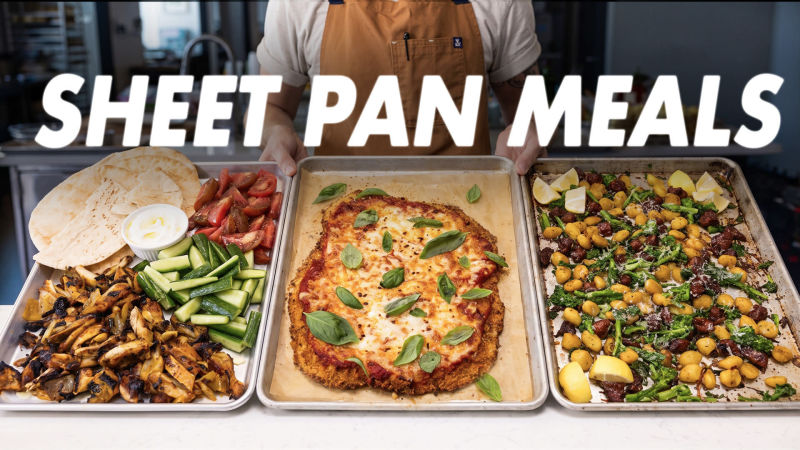
Bon Appétit’s Jesse Szewczyk shows how to get the most out of your oven with three sheet pan dinners designed for every rack. Learn how to use the bottom rack for crispy, oven-fried chicken parm, the middle rack for perfectly roasted gnocchi with sausage and broccoli rabe, and the broiler for smoky, charred shawarma-spiced chicken. Use Jesse’s tips and techniques to unlock your oven’s full potential and make your weeknights a little easier.
Feeling inspired? You can follow these recipes here:
Chicken Parm: https://slim-weight.today/recipe/a-really-big-chicken-parm
Sheet Pan Gnocchi: https://slim-weight.today/recipe/sheet-pan-gnocchi-spicy-sausage-broccoli-rabe?_sp=36d48b46-a52f-431b-9818-bb9820bd4945.1786372123359
Chicken Shawarma: https://slim-weight.today/recipe/sheet-pan-shawarma-spiced-chicken
Discover more of Chef Skylar's recipes here: https://diningwithskyler.com/

icon
Jonathan Wu of NYC's Fung Tu shows us the move every pro chef knows how to do blindfolded.

icon
Bon Appétit spends a day on the line with Chef Nino Coniglio, owner of Lucky Charlie in Brooklyn. A world champion pizza maker, Coniglio's newest venture focuses on making New York-style pizza in the city’s oldest coal oven from the 1890s.

icon
When it comes to all things culinary, Test Kitchen chef Molly Baz has attempted many complicated and rarefied cooking techniques, but she's never tried pancake art. Join her as she tries to master the instagramable medium that is pancake art through a series of 7 challenges.
Check out Brek Nebel's Instagram: https://www.instagram.com/pancakebrekfast/
Visit Jasmine Rezonable's website: http://getcakedla.com/